Complete Health Insurance Guide for Digital Nomads (2026)
Three years ago, I quit my marketing job in Seattle and bought a one-way ticket to Lisbon. I had savings, a laptop, freelance clients lined up, and absolute confidence in my plan. What I didn’t have was proper health insurance the kind of flexible, affordable coverage like SafetyWing that didn’t exist back then or that I simply didn’t know about. I assumed my domestic U.S. health insurance would somehow cover me abroad, or that I could just buy travel insurance at the airport like I did for vacations.
That assumption nearly destroyed my nomadic dream four months later when I contracted a severe respiratory infection in Chiang Mai. The emergency room visit, chest X-rays, medications, and follow-up appointments cost $2,100 out-of-pocket because my U.S. insurance didn’t cover international care and I had no travel insurance. That single medical incident consumed nearly a month of my carefully budgeted living expenses.
Insurance represents one of the most confusing yet critical aspects of sustainable digital nomad life. Unlike traditional travelers taking two-week vacations, we live abroad for months or years, crossing borders constantly, working remotely from dozens of countries, and needing healthcare access that doesn’t expire after 90 days. Standard travel insurance doesn’t fit our lifestyle, domestic health insurance rarely covers international care, and comprehensive international health insurance often costs more than our monthly accommodation budget.
The digital nomad insurance landscape has evolved dramatically since 2020. New providers designed specifically for location-independent professionals now offer flexible coverage, monthly subscriptions, and policies that actually align with how we live and work. Understanding your options, choosing appropriate coverage, and avoiding expensive mistakes protects both your health and your ability to sustain the nomadic lifestyle long-term.
This guide breaks down everything you need to know about health insurance as a digital nomad: which providers offer the best value, what coverage actually costs across different age brackets and destinations, how to meet visa requirements in popular nomad countries, when you need comprehensive health insurance versus basic travel coverage, and which mistakes cost nomads thousands in denied claims and out-of-pocket expenses.
Best Health Insurance Companies for Digital Nomads in 2026
The insurance market for digital nomads has consolidated around several key providers, each serving different needs and budgets. Choosing the right one depends on your age, health status, destinations, and whether you prioritize flexibility or comprehensive coverage.
SafetyWing has become the default choice for most digital nomads under 40. Their Nomad Insurance product operates on a monthly subscription model at $56 for travelers under 40, with automatic renewal every 28 days. You can purchase coverage from anywhere in the world, even after you’ve already started traveling, and the policy covers 185 countries without requiring pre-approval for border crossings. The coverage limit is $250,000 for emergency medical expenses, hospitalization, and medical evacuation, with a $250 deductible per incident. What makes SafetyWing particularly valuable is the limited home country coverage 30 days per 90-day period letting you visit home occasionally without losing protection entirely.
SafetyWing’s Nomad Insurance has become the most popular choice among digital nomads for good reason affordable monthly pricing, worldwide coverage, and zero hassle. Get protected with SafetyWing starting at $56/month →
The limitations are worth understanding. SafetyWing doesn’t cover routine medical care like annual checkups or preventive screenings. Pre-existing conditions receive no coverage. Dental care is limited to emergency treatment only. It’s fundamentally emergency-focused insurance designed to protect you from catastrophic medical expenses rather than comprehensive healthcare coverage. For healthy nomads who rarely need medical care and primarily want protection against worst-case scenarios, this model provides exceptional value.
Genki launched in 2019 targeting European digital nomads with even lower pricing at €39.90 monthly (approximately $43) for travelers under 35. The standout feature is zero deductible, meaning Genki covers eligible medical expenses from the first euro rather than requiring you to pay $250 upfront before coverage begins. Maximum coverage reaches €1 million, significantly higher than SafetyWing’s $250,000 limit. Genki also includes dental emergencies, physiotherapy, and pregnancy complications that SafetyWing excludes.
The major limitation is that Genki doesn’t cover the United States at all, eliminating it for American nomads who visit home or anyone planning time in the U.S. The company is also relatively new with less long-term feedback about complex claims and customer service during serious emergencies. For European nomads who never visit America, Genki offers slightly better value than SafetyWing with the zero-deductible benefit and higher coverage limits.
World Nomads has operated since 2002 and dominates the adventure travel insurance market. If your digital nomad lifestyle includes regular activities like scuba diving, rock climbing, skiing, or motorcycling, World Nomads provides the most comprehensive adventure coverage available. Plans start around $80 monthly but vary dramatically based on age, nationality, and coverage level. The Standard plan covers emergency medical up to $100,000, while the Explorer plan increases that to $300,000 and adds coverage for more extreme activities.
Unlike SafetyWing and Genki’s subscription models, World Nomads operates as traditional trip insurance with defined start and end dates. You can extend coverage while traveling, but it’s less flexible than month-to-month renewal. The company also covers trip cancellation, lost luggage, and gear theft, making it more comprehensive travel protection beyond just medical coverage. The tradeoff is cost easily $500-800 for six months of coverage compared to $336 for SafetyWing over the same period.
Cigna Global and IMG Global represent a significant step up in both coverage and cost, providing true international health insurance rather than emergency-only travel coverage. Cigna plans start around $200 monthly but include routine care, prescriptions, mental health services, dental and vision coverage, and pre-existing conditions after waiting periods. These providers operate globally with direct billing arrangements at thousands of hospitals, meaning you show your insurance card and receive treatment without paying upfront and waiting for reimbursement.
This comprehensive coverage makes sense for older nomads, families with children, or anyone with chronic conditions requiring ongoing medical care. For a healthy 28-year-old who needs a doctor twice annually, paying $200 monthly ($2,400 annually) for comprehensive coverage is overkill when SafetyWing at $56 monthly ($672 annually) plus $200 in out-of-pocket routine care totals just $872 annually a $1,528 difference that could fund an extra month of nomad living.
The right provider depends entirely on your personal situation. Most healthy nomads under 40 find SafetyWing or Genki provides adequate protection at affordable prices. Adventure-focused nomads should seriously consider World Nomads despite higher costs. Older nomads or those with families benefit from comprehensive coverage through Cigna or IMG Global even though premiums are substantially higher. Comparing the best digital nomad insurance providers in detail helps you evaluate specific coverage features, pricing across age brackets, claims experiences, and real user feedback to make an informed decision matching your needs and budget.
How Much Does Digital Nomad Insurance Cost? (2026 Pricing)
Understanding the true cost of digital nomad insurance requires looking beyond monthly premiums to consider age-based pricing, coverage levels, geographic factors, and out-of-pocket expenses that impact your total annual healthcare spending.
Age represents the single biggest factor determining your insurance premium. Under-30 travelers pay the lowest rates, typically $45-75 monthly for basic emergency coverage. SafetyWing charges $56 monthly through age 39, while Genki costs €39.90 (approximately $43) for under-35s. At this age bracket, you’re accessing the best rates available across all providers.
The significant price jump occurs at age 40. SafetyWing increases to approximately $140 monthly for 40-49 year-olds, nearly triple the under-40 rate. World Nomads pricing reaches $150-200 monthly in this age bracket. Comprehensive plans from Cigga Global start around $250-300 monthly. This dramatic increase reflects actuarial data showing that travelers over 40 statistically require more medical care than younger counterparts.
Costs continue climbing steeply beyond 50. SafetyWing charges $180-220 monthly for travelers in their fifties, while comprehensive international health insurance easily exceeds $400 monthly. After age 60, insurance becomes expensive and harder to find, with SafetyWing charging $280+ monthly and comprehensive coverage ranging from $500 to $800 monthly depending on specific benefits and provider.
Coverage level directly impacts pricing beyond age considerations. Basic emergency coverage with $50,000-100,000 limits costs $45-80 monthly for under-40 travelers. Standard coverage with $250,000-500,000 limits runs $56-120 monthly depending on age and provider. Premium coverage exceeding $1 million costs $200-400 monthly. Comprehensive health insurance with unlimited coverage, routine care, prescriptions, and dental services reaches $250-800 monthly based on age and specific plan features.
For most healthy digital nomads under 40, SafetyWing at $56 monthly delivers exceptional value less than $2 per day for $250,000 in emergency medical coverage.
Geographic coverage creates substantial cost variations. Including the United States in your coverage area increases premiums by 40-80% because American healthcare costs are extraordinarily high compared to every other country. A broken arm costing $800 in Portugal or $1,200 in Germany runs $7,500-15,000 in the United States. Insurance companies charge massive premiums to cover U.S. medical treatment, which is why many providers either exclude America entirely or offer separate pricing tiers.
Genki doesn’t cover the U.S. at all, keeping costs low. SafetyWing includes limited U.S. coverage (30 days per 90-day period) in their standard price. If you’re an American nomad regularly visiting home or anyone planning extended U.S. time, budget an extra $30-80 monthly compared to policies excluding the United States.
Deductibles significantly affect both monthly premiums and out-of-pocket costs during medical situations. Genki offers zero-deductible coverage where they cover eligible expenses from the first euro, providing predictable costs without surprise out-of-pocket expenses. SafetyWing’s $250 deductible per incident means you pay the first $250 of each separate medical issue before insurance coverage begins. Higher deductibles of $500-1,000 reduce monthly premiums by $20-40 but increase your immediate costs when needing care.
Realistic annual budgets for different nomad profiles include both premiums and expected out-of-pocket expenses. Young healthy nomads under 30 should budget $600-900 annually. Mid-career nomads aged 30-40 need $800-1,400 annually. Established nomads aged 40-50 require $1,700-2,500 annually. Senior nomads over 50 should plan for $2,500-6,000 annually. Families of three need $4,000-8,000 annually for adequate coverage including children.
Hidden costs beyond monthly premiums affect total insurance spending. Out-of-pocket medical expenses for deductibles, co-pays, and uncovered services typically add $200-500 annually even with insurance. Reimbursement delays mean you’ll pay upfront for treatment and wait 2-6 weeks for repayment, requiring accessible savings to cover initial costs. Currency conversion fees add 2-4% to effective costs if you’re paying in currencies different from your income. Coverage gaps during policy transitions create uninsured periods where you’re completely exposed.
Understanding exactly how much digital nomad insurance costs across different scenarios with detailed pricing by age bracket, destination, coverage level, and provider helps you budget appropriately and avoid either overpaying for unnecessary coverage or underinsuring yourself against catastrophic medical expenses that could end your nomadic lifestyle.

Digital Nomad Visa Insurance Requirements by Country
Securing a digital nomad visa requires meeting specific insurance requirements that vary dramatically across countries. These requirements represent one of the most confusing aspects of visa applications, and submitting incorrect documentation is among the most common reasons for rejection.
Countries impose insurance requirements to ensure foreign residents won’t burden their public healthcare systems or become stranded without resources during medical emergencies. Different nations emphasize different aspects European countries typically require higher coverage minimums and specific inclusions like repatriation, while Southeast Asian countries often accept lower minimums but require proof of worldwide coverage.
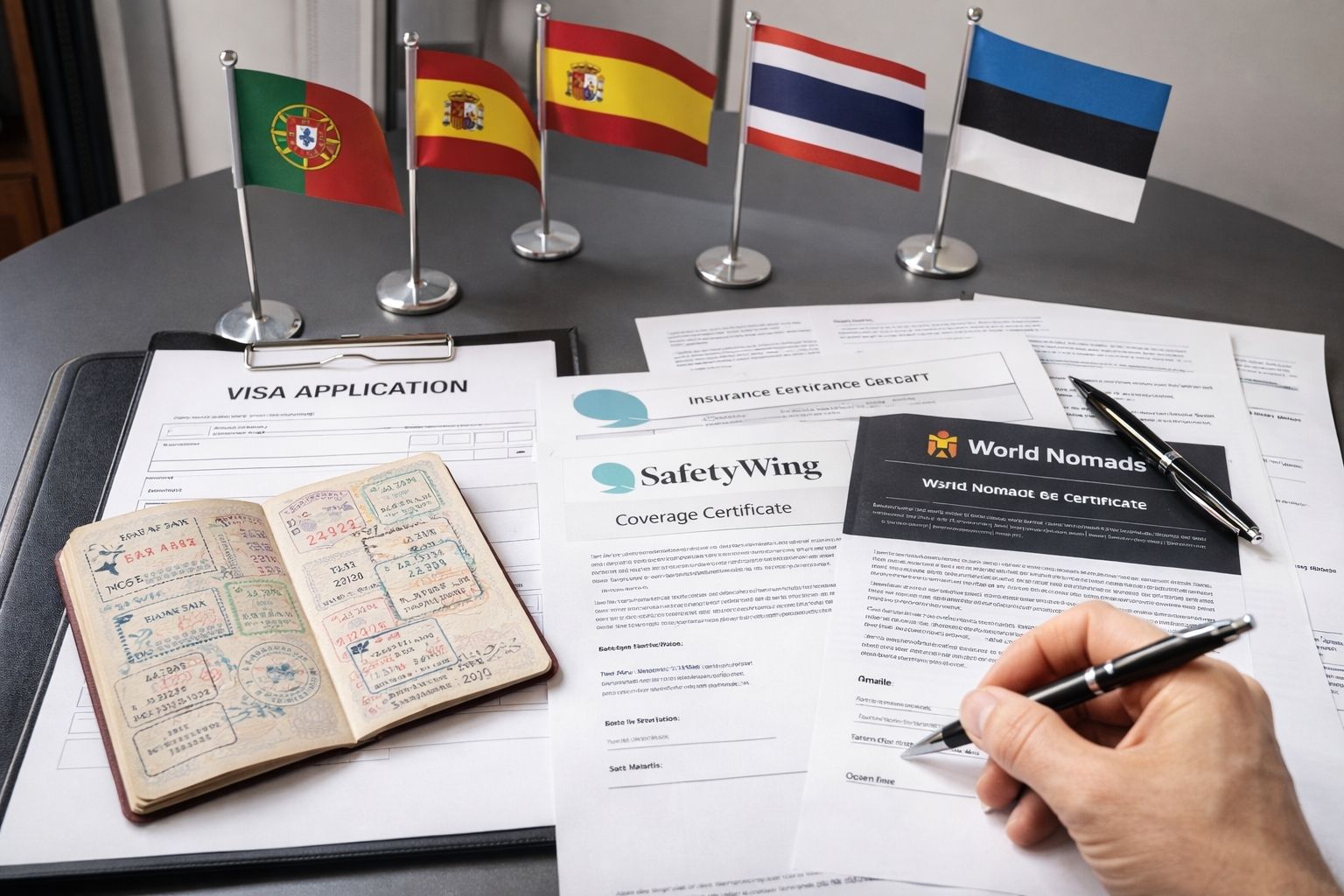
Portugal’s D7 passive income visa and D8 digital nomad visa both require comprehensive health insurance with minimum coverage of €30,000 for medical expenses, hospitalization, and repatriation of remains. Portugal accepts Portuguese national health insurance after obtaining residency, private Portuguese health insurance from companies like Médis or Advancecare, or international travel and health insurance from recognized providers. SafetyWing’s $250,000 coverage limit easily exceeds the €30,000 minimum and includes repatriation, making it acceptable for initial applications. The documentation requirement is critical you need an insurance certificate or policy document in English or Portuguese clearly stating coverage minimums, coverage territory including Portugal, policy dates, and your name exactly matching your passport.
Spain’s digital nomad visa requires private health insurance authorized to operate in Spain with “full coverage and no copayments.” The minimum coverage amount is €30,000, matching Portugal’s requirement. However, Spain’s interpretation of “no copayments” technically excludes most travel insurance policies with deductibles. In practice, many applicants successfully use SafetyWing or similar providers by including a letter explaining that deductibles apply to reimbursement rather than initial treatment access. Spanish consulates have discretion in interpreting requirements, leading to inconsistent application experiences across different locations.
Estonia takes a simpler approach, requiring health insurance valid in Estonia covering the entire visa period with no specified minimum coverage amount in official documentation. Estonian immigration accepts most international travel insurance policies including SafetyWing, World Nomads, or Genki. The key is ensuring your policy explicitly covers Estonia and matches your visa dates. Estonia’s entirely online application process is highly efficient, typically processing within 15-30 days if insurance documentation is clear.
Croatia requires health insurance for the duration of your stay with minimum coverage of €30,000 covering emergency medical treatment, hospitalization, and medical repatriation. Croatia explicitly accepts travel insurance, making SafetyWing, World Nomads, and similar providers clearly eligible. One important note is that if you’re applying for the one-year digital nomad residence permit rather than the short-stay visa, you need insurance covering the full twelve months continuously, not just multiple short trips.
Thailand’s Long-Term Resident visa program includes a “Work-from-Thailand Professional” category with age-based insurance requirements. If you’re under 50, you must have health insurance with minimum coverage of $50,000 covering outpatient and inpatient treatment in Thailand. If you’re 50 or older, Thailand requires $100,000 minimum coverage, effectively doubling the requirement. Thailand accepts international health insurance from recognized providers, and SafetyWing’s $250,000 coverage exceeds both minimums. However, some applicants report that Thai immigration specifically asks whether insurance covers treatment in Thailand, so ensure your policy documentation explicitly mentions Thailand or states “worldwide coverage” clearly including Thailand.
Indonesia currently uses B211A tourist visas for most digital nomads while developing an official five-year nomad visa launching sometime in 2026. The B211A visa requires travel insurance covering the visa period with minimum coverage of $25,000 for medical expenses. The insurance must cover Indonesia specifically and match your visa dates exactly Indonesian consulates are particularly strict about date matching, so if your visa starts March 15, your insurance cannot start March 16.
Mexico’s temporary resident visa doesn’t explicitly require health insurance as part of the application, though Mexican consulates have discretion to request proof of insurance as supplementary documentation demonstrating you can support yourself. While not mandatory, including insurance documentation with your application prevents potential complications, as immigration officers occasionally ask for insurance proof at the border even if your visa was approved without it.
Costa Rica’s Rentista visa program adapted for digital nomads requires health insurance covering medical expenses in Costa Rica with no specified minimum coverage amount. The insurance must technically be issued by a company authorized to operate in Costa Rica, which excludes most international travel insurance. However, many applicants successfully use international providers by submitting policy documentation showing Costa Rica coverage. The safest approach uses Costa Rican insurance companies like INS or Sagicor, which typically cost $100-200 monthly and provide comprehensive local coverage.
Dubai’s Virtual Working Program requires health insurance valid in the UAE with no specified minimum coverage amount, but insurance must cover medical treatment in UAE facilities. The challenge is that most international travel insurance policies don’t cover routine care, which UAE immigration sometimes questions. The most straightforward approach is purchasing UAE-based health insurance from providers like Dubai Insurance Company or Orient Insurance at $150-300 monthly.
Common documentation mistakes cause repeated visa rejections. Missing repatriation coverage causes problems in European countries requiring it explicitly mentioned in policy documents. Date mismatches where insurance dates don’t exactly match or exceed visa periods trigger automatic rejections. Wrong policy type occurs when countries require “health insurance” rather than “travel insurance” and immigration officers reject travel insurance policies. Insufficient coverage amounts happen when minimums specified in euros don’t align with policies providing dollar amounts at unfavorable exchange rates. Missing territory confirmation creates issues when policies don’t explicitly name the destination country.
Successful insurance documentation requires several strategies. Apply for insurance first before starting your visa application to ensure policy dates align properly with intended travel dates. Request detailed certificates showing coverage amounts, territories, policy dates, repatriation inclusion, and personal details matching your passport exactly. Get provider letters on company letterhead confirming the policy meets specific visa requirements for countries with ambiguous rules. Keep digital and physical copies since immigration can request insurance proof at the border even with approved visas. Set renewal reminders to ensure continuous coverage throughout your entire visa period, especially for policies renewing every 28 days.
Learning the specific digital nomad visa insurance requirements by country with detailed documentation guidelines, accepted providers, and real application experiences prevents expensive rejections and ensures your insurance actually satisfies the requirements of your target destinations.
Travel Insurance vs Health Insurance: What Digital Nomads Actually Need
The distinction between travel insurance and international health insurance confuses most digital nomads, leading to dangerous coverage gaps that only become apparent when filing claims or facing denied reimbursements for legitimate medical care.
Travel insurance is designed for temporary trips with defined start and end dates. It protects against trip-specific risks including flight cancellations, lost luggage, emergency medical situations while away from home, and medical evacuation back to your home country. The fundamental assumption is that you’re temporarily leaving home where you maintain regular health insurance, then returning after your trip ends. Coverage focuses on unexpected emergencies interrupting your journey rather than ongoing healthcare needs.
Health insurance provides continuous medical coverage for people living somewhere long-term. It covers routine doctor visits, prescription medications, preventive care including annual checkups and screenings, specialist consultations, chronic condition management, and hospitalization. Health insurance assumes you’re a resident of the coverage area who will access healthcare regularly over months or years as a normal part of life requiring consistent provider relationships.
Digital nomads fall into a gray area between these categories. We’re not taking temporary trips from permanent homes, yet we’re also not traditional residents of any single country. We live abroad semi-permanently, moving between countries every few months or years, needing emergency protection like travelers but also requiring reliable healthcare access like residents.
Travel insurance covers emergency medical treatment for acute situations requiring immediate care accidents, sudden illness, or any medical emergency. Coverage includes emergency room visits, hospitalization, surgery, and related care up to policy limits typically ranging from $50,000 to $500,000. Medical evacuation covers transportation to adequate medical facilities if local care is insufficient, potentially costing $50,000-100,000 for emergency airlift from remote locations. Adventure activity coverage from providers like World Nomads includes injuries from activities like scuba diving, rock climbing, or motorcycling that traditional health insurance often excludes.
However, travel insurance excludes routine and preventive care including annual physical exams, vaccinations, health screenings, and prescription refills for maintenance medications. Pre-existing medical conditions receive no coverage or severely limited coverage even with waivers. Mental health services are typically excluded or capped at very low limits. Pregnancy and maternity care is almost always excluded except for unexpected complications. Extended treatment beyond initial emergency stabilization becomes murky, with policies potentially stopping payment after emergency treatment even if full recovery requires ongoing care.
International health insurance operates like domestic health insurance but provides coverage across multiple countries. Comprehensive medical care including inpatient hospitalization, outpatient doctor visits, specialist consultations, diagnostic tests, surgery, and emergency care all receive coverage. Prescription medications are covered through pharmacy benefits or as part of outpatient care, saving hundreds or thousands monthly for those taking daily medications. Preventive and routine care including annual checkups, cancer screenings, and vaccinations receive coverage on comprehensive plans. Pre-existing conditions receive coverage after waiting periods typically lasting 12-24 months. Maternity coverage is available as an add-on with prenatal care, delivery, and newborn care covered after waiting periods. Mental health services receive better coverage with therapy, psychiatric care, and medications typically covered up to annual limits.
The tradeoff is cost. International health insurance typically costs $200-800 monthly depending on age and coverage level, compared to $45-120 monthly for travel insurance. You’re paying for ongoing healthcare access rather than emergency-only protection.
Digital nomad insurance emerged as a hybrid category recognizing that traditional travel insurance doesn’t meet nomad needs but comprehensive health insurance is prohibitively expensive for many location-independent workers. SafetyWing’s Nomad Insurance operates as travel medical insurance covering emergency care, hospitalization, medical evacuation, and some outpatient treatment for acute illness or injury. The monthly subscription model with automatic renewal fits nomadic lifestyles better than traditional travel insurance with fixed trip dates. Limited home country coverage lets you visit home occasionally without losing protection completely, unlike traditional travel insurance typically excluding home countries entirely.
However, digital nomad insurance maintains travel insurance limitations. Pre-existing conditions remain excluded, routine care receives no coverage, and the focus stays on emergency medical situations rather than comprehensive healthcare access. This hybrid model works well for young, healthy nomads who rarely need medical care and primarily want protection against catastrophic expenses. It falls short for nomads with chronic conditions, those planning families, or anyone wanting routine healthcare access.
Your ideal insurance depends entirely on your personal situation. Young healthy nomads in their twenties and thirties without chronic conditions find travel insurance or digital nomad insurance provides the best value at $50-80 monthly for emergency protection without overpaying for comprehensive benefits they won’t use. Mid-career nomads in their thirties and forties who are generally healthy still benefit from digital nomad insurance, though budgeting for out-of-pocket healthcare expenses in addition to premiums becomes important. Nomads with chronic conditions requiring ongoing care need international health insurance despite higher costs of $300-500 monthly, since it’s cheaper than paying thousands out-of-pocket for specialist visits, prescription medications, and regular monitoring. Families with children require comprehensive international health insurance for regular pediatric checkups, vaccinations, and occasional sick visits. Older nomads over 50 should consider comprehensive coverage even if currently healthy since the likelihood of needing regular medical care increases with age.
Many experienced nomads adopt hybrid strategies combining travel or digital nomad insurance for emergency coverage while paying out-of-pocket for routine care in countries with affordable healthcare. You maintain SafetyWing at $56 monthly for catastrophic protection, then pay $30-80 for doctor visits in Portugal, $25-50 in Mexico, or $40-100 in Thailand when needing routine care. This works brilliantly in countries where private healthcare costs less than insurance premiums.
Understanding the real differences between travel insurance and health insurance for digital nomads with detailed coverage comparisons, cost analyses, and recommendations by nomad profile helps you choose the right insurance type for your actual healthcare needs rather than assuming one solution fits all situations across years of nomadic life.
Common Digital Nomad Insurance Mistakes
Even experienced digital nomads make critical insurance mistakes that result in denied claims, unexpected bills exceeding thousands of dollars, or dangerous gaps in coverage during medical emergencies abroad. These errors are entirely avoidable with proper understanding and planning, yet they occur constantly across nomad communities.
The most dangerous mistake is choosing coverage limits that seem adequate until you actually need them. Many budget-conscious nomads select the cheapest insurance option with minimal coverage limits sometimes as low as $25,000 or $50,000 to save $20-30 monthly on premiums. A $50,000 coverage limit sounds substantial until you’re hospitalized for two weeks with dengue fever complications and the bill reaches $45,000, leaving you $5,000 away from financial catastrophe with days still remaining in the hospital.
Consider realistic worst-case scenarios. A broken leg requiring surgery costs $8,000-15,000 in most countries. Appendicitis surgery runs $5,000-12,000. A week of hospitalization for pneumonia reaches $10,000-20,000. Medical evacuation from a remote location to adequate facilities can cost $50,000-100,000 alone before any actual treatment begins. If you’re in a serious accident requiring surgery, intensive care, and two weeks of hospitalization, costs easily reach $40,000-80,000 even in countries with relatively affordable healthcare. In expensive destinations like the United States, Switzerland, or Japan, identical care costs $100,000-250,000.
The solution is choosing coverage limits of at least $250,000, preferably $500,000 or higher. Yes, this means paying slightly more monthly perhaps $70 instead of $45 but that extra $25 monthly totaling $300 annually protects you against potentially bankrupting medical bills that could immediately end your nomadic lifestyle.
Ignoring adventure sports exclusions before participating in adventure activities represents another critical mistake. Digital nomads love adventure scuba diving in Indonesia, rock climbing in Thailand, motorcycling through Vietnam, skydiving in New Zealand. Most standard insurance policies exclude these activities entirely or require specific riders adding adventure coverage. Standard travel insurance typically covers walking, swimming, and low-risk activities, but the moment you rent a motorcycle, go scuba diving below certain depths, or participate in any activity the insurance company deems risky, your coverage evaporates completely. If you’re injured during an excluded activity, your claim will be denied regardless of how severe the injury or expensive the treatment.
The solution requires two steps. First, carefully read your policy’s activity exclusions before participating in any adventure activities. Every policy includes a detailed list of excluded activities, usually buried in the policy document PDF. Find this list and read it completely before booking that scuba diving trip or renting that motorcycle. Second, if you plan regular adventure activities, choose insurance designed for adventurous travelers. World Nomads built their entire business around adventure coverage, including motorcycling with proper licenses, scuba diving, rock climbing, skiing, and dozens of other activities. The $80-150 monthly cost is higher than SafetyWing’s $56, but if you’re regularly doing these activities, it’s essential coverage rather than optional luxury.
Not understanding deductibles and how they actually work causes confusion and surprise expenses. Many nomads choose policies based on monthly premiums without fully understanding how deductibles affect their actual out-of-pocket costs during medical situations. A deductible is the amount you pay before insurance coverage begins. SafetyWing has a $250 deductible per incident, meaning for each separate medical issue, you pay the first $250 of costs. If you visit a doctor for a sinus infection costing $120, you pay all $120 out-of-pocket because it doesn’t exceed your deductible insurance covers nothing. If that infection worsens and you’re hospitalized for $3,000, you pay $250 and insurance covers the remaining $2,750.
The confusion intensifies with “per incident” versus “annual” deductibles. SafetyWing’s per-incident deductible means each separate medical issue triggers a new $250 deductible. If you have three unrelated medical situations in one year, you pay $250 three times totaling $750 before insurance covers anything. Some policies use annual deductibles where you pay a set amount once per year, then insurance covers everything else for the remainder of that year.
The mistake is choosing low monthly premiums with high deductibles without maintaining adequate savings to cover those deductibles. If you choose a policy with a $2,500 deductible to save $40 monthly but don’t have $2,500 in accessible savings, you’re not actually insured in any meaningful way for mid-level medical situations costing $3,000-5,000. Match your deductible to your emergency savings if you maintain $5,000 in savings for emergencies, a $1,000 deductible is manageable, but if you operate on tight budgets with minimal savings, choose lower deductibles even if monthly premiums are slightly higher.
Failing to declare pre-existing conditions creates serious problems during claims. Pre-existing conditions are medical issues you had before purchasing insurance, and most travel insurance excludes them entirely. Many nomads don’t realize that the definition of “pre-existing” is broader than they think. Insurance companies typically define pre-existing conditions as any medical issue for which you received treatment, consultation, diagnosis, or prescribed medication within the past 6-12 months before purchasing coverage. This means if you saw a doctor for back pain eight months ago, that’s a pre-existing condition even if it’s completely resolved now.
The mistake happens when nomads assume “pre-existing condition” only means chronic illnesses like diabetes or heart disease. In reality, it includes recent injuries, previous surgeries, mental health treatment, even routine consultations that didn’t lead to any diagnosis. Insurance companies access medical records when investigating claims, especially for expensive hospitalizations or surgeries. They look for any prior mention of similar symptoms or related conditions, then use that information to deny claims as pre-existing.
If you have true pre-existing conditions requiring ongoing care, don’t rely on travel insurance at all. Choose comprehensive international health insurance from providers like Cigna Global, Allianz Care, or Aetna International that cover pre-existing conditions after waiting periods typically lasting 12-24 months. These policies cost $300-500 monthly but actually cover your conditions rather than excluding them permanently.
Overlooking home country coverage exclusions catches many digital nomads off guard. Most travel insurance policies either exclude your home country entirely or severely limit coverage during home visits. The logic is that travel insurance is designed for traveling away from home, not for living in your home country. Insurance companies expect you to maintain regular health insurance at home and use travel insurance only while abroad.
For digital nomads without permanent homes or domestic health insurance, this creates dangerous coverage gaps. You’re insured everywhere in the world except your country of citizenship, which is often where you visit family, handle bureaucratic tasks, or take breaks between international destinations. SafetyWing partially addresses this with limited home country coverage of 30 days per 90-day period. If you visit the U.S. for two weeks twice yearly, you’re covered. If you spend two months home, you’re uninsured for the second month.
The mistake is not tracking your home country days and accidentally exceeding coverage limits without realizing it. If you’re injured on day 35 of a 40-day home visit, insurance won’t cover your treatment because you exceeded the 30-day limit. You’ll pay entirely out-of-pocket despite paying for insurance. Track your days carefully if you have limited home country coverage, or choose international health insurance providing worldwide coverage including your home country without day limitations.
Not understanding the claims process and reimbursement timing creates financial stress. Many digital nomads assume insurance works like it does at home show your card at the doctor’s office, get treatment, pay a small co-pay, and walk out. International travel insurance rarely works that way. Most policies require you to pay upfront for treatment, then submit claims for reimbursement weeks or months later.
This creates two problems. First, you need accessible funds to cover medical expenses upfront. A $3,000 emergency room visit requires having $3,000 available immediately, even though insurance will eventually reimburse most of it. Second, reimbursement takes time. SafetyWing typically processes claims within 2-4 weeks. World Nomads can take 4-6 weeks. Some providers take even longer for complex claims requiring additional documentation or medical record review.
The solution starts with maintaining emergency savings specifically for medical expenses. Budget $3,000-5,000 in accessible funds you can use to pay upfront for treatment without disrupting your monthly budget. Understand your insurance company’s claims process before needing it. Collect all documentation immediately including itemized receipts, medical reports, diagnosis codes, and prescription information. Submit claims immediately rather than waiting to accumulate several receipts. Keep digital and physical copies of everything since insurance companies frequently request additional documentation weeks after initial submission.
Letting coverage lapse between policies represents the final critical mistake. This happens during policy transitions when switching providers, during periods when nomads return home and think they don’t need coverage, or when automatic renewals fail and nomads don’t notice for weeks. Insurance only covers incidents occurring while coverage is active. If your policy expires March 15 and you don’t renew until March 22, anything happening during those seven days is completely uncovered. One week seems insignificant until you’re in an accident March 18 facing $25,000 in medical bills with no insurance.
Treat insurance like any essential subscription service you never let lapse. Set reminders before renewal dates. Enable automatic renewal on policies that offer it. When switching providers, overlap coverage by several days if your World Nomads policy expires March 31, activate your SafetyWing policy March 29 so you have two days of dual coverage. The extra $5-10 for brief dual coverage is worthwhile insurance for your insurance, eliminating any gap risk.
Avoiding these seven critical digital nomad insurance mistakes with detailed explanations of why they happen, real examples of denied claims and expensive consequences, and practical solutions for each error protects both your financial security and your ability to continue living the location-independent lifestyle you’ve worked hard to achieve.

Conclusion
Health insurance represents one of the most critical yet frequently misunderstood aspects of sustainable digital nomad life. The difference between adequate coverage and dangerous gaps often only becomes apparent during medical emergencies when it’s too late to make changes. Getting insurance right from the beginning protects both your health and your financial ability to continue living location-independently.
The digital nomad insurance landscape has matured significantly in recent years. Specialized providers now offer flexible coverage designed specifically for our unique lifestyle monthly subscriptions that renew automatically, worldwide coverage across 150-185 countries, the ability to purchase and activate policies while already traveling, and limited home country coverage for visits between international destinations. These innovations make insurance far more accessible and practical than relying on traditional travel insurance designed for two-week vacations or comprehensive international health insurance costing $500-800 monthly.
For most healthy digital nomads under 40, providers like SafetyWing at $56 monthly or Genki at €39.90 monthly deliver excellent value. You’re paying $600-700 annually for $250,000 to €1 million in emergency medical coverage, hospitalization, and medical evacuation protection against the catastrophic expenses that could immediately end your nomadic journey. This emergency-focused coverage works brilliantly when combined with out-of-pocket payments for routine care in countries with affordable healthcare like Portugal, Mexico, Thailand, or dozens of other popular nomad destinations where doctor visits cost $30-80.
As you age, develop chronic conditions, or expand your family, reassessing your insurance needs becomes essential. What worked perfectly at 28 may provide inadequate protection at 45. The $140-280 monthly that comprehensive international health insurance costs seems expensive until you calculate the actual costs of managing chronic conditions, regular specialist visits, prescription medications, or raising children while traveling. Sometimes paying more for genuine health insurance rather than emergency-only travel insurance is the responsible choice.
Understanding visa requirements prevents expensive application mistakes. Portugal requires €30,000 minimum coverage with repatriation. Spain demands “no copayment” policies that technically exclude most deductible-based travel insurance. Thailand requires $50,000-100,000 depending on your age. Estonia accepts almost any international policy covering Estonia. Each country sets different standards, accepts different provider types, and requires specific documentation. Submitting correct insurance documentation the first time saves months of delays and hundreds in reapplication fees.
The mistakes that cost nomads thousands in denied claims and out-of-pocket expenses are entirely avoidable. Choose coverage limits of at least $250,000. Read adventure sports exclusions before participating in risky activities. Understand how your deductible actually works. Never let coverage lapse between policies. Track your home country days if you have limited coverage. Maintain emergency savings for upfront medical payments. These simple practices prevent the vast majority of expensive insurance problems.
Insurance isn’t exciting. Reading policy documents doesn’t feel productive compared to booking flights or researching destinations. But spending two hours understanding your coverage, confirming it meets your needs, and avoiding common mistakes provides more value than almost any other two hours you’ll invest in your nomadic lifestyle. One serious medical situation without proper insurance can cost more than years of premiums I’ve watched it happen to friends who assumed they were covered only to discover critical exclusions during emergencies.
The goal isn’t finding the absolute cheapest insurance. The goal is finding adequate coverage that protects you against financial catastrophe while fitting your budget and lifestyle. For some nomads, that’s $56 monthly for SafetyWing. For others, it’s $300 monthly for comprehensive Cigna Global coverage. Both choices can be correct depending on your personal situation, health status, age, and risk tolerance.
Start by honestly assessing your health needs, planned activities, target destinations, and budget constraints. Compare the best digital nomad insurance providers to find the option matching your requirements. Calculate realistic costs including premiums and expected out-of-pocket expenses. Verify your chosen policy meets visa requirements for your target countries. Read the entire policy document focusing on exclusions, deductibles, and claims processes. Set up automatic renewal and calendar reminders. Maintain emergency savings for upfront medical costs.
For most healthy digital nomads under 40, I recommend starting with SafetyWing at $56 monthly. It’s what I use personally, and it’s protected me across 30+ countries over three years.
Insurance represents protection against worst-case scenarios, not the most cost-effective way to pay for predictable healthcare you know you’ll need. A healthy nomad overpaying for comprehensive coverage they never use wastes money better spent on experiences and travel. But a nomad with inadequate emergency coverage facing $50,000 in hospitalization costs discovers too late that saving $200 monthly on premiums was a catastrophic mistake that ends their nomadic lifestyle.
Get your insurance right, then stop thinking about it. The best insurance is coverage you maintain continuously, understand completely, and hopefully never need to use. That peace of mind lets you focus on the experiences, opportunities, and freedom that motivated you to become location-independent in the first place.